

What are sulfites in wine, and what do EU rules call them?
Sulfites are sulphur-containing compounds covered by European Commission rules for EU winemaking. Total sulphur dioxide is the regulatory measure used in the European Commission’s EU rules when limits and labelling thresholds are applied to wine. Commission Regulation (EU) 2019/934 sets the oenological practices and permitted substances for EU winemaking, including sulphur dioxide.
VinSip uses “sulfites” as the general term throughout this guide. VinSip retains the spelling “sulphites” in the required label wording “contains sulphites” and in the production claim “no added sulphites.” VinSip uses “total sulphur dioxide” whenever the subject is an EU ceiling, a labelling threshold or a measured regulatory amount.
The European Commission’s treatment of sulphur dioxide as a permitted oenological substance means that its presence is not, by itself, evidence that a wine is defective or outside ordinary EU winemaking practice. Commission Regulation (EU) 2019/934 provides the regulatory framework for permitted oenological practices rather than a quality ranking for bottles. A wine’s compliance with that framework therefore does not establish whether an individual drinker will prefer its style, aroma, flavour or production philosophy.
Total sulphur dioxide is not the same concept as an added amount. The European Commission’s limits concern total sulphur dioxide in the finished regulatory category, while a “no added sulphites” claim describes a producer’s choice about addition. A production claim about addition therefore cannot be read as a measured statement of total sulphur dioxide unless the producer also supplies a measurement.
The European Commission’s EU ceilings also show that wine colour alone is not a reliable guide to which dry category has the higher permitted amount. The European Commission’s EU limit for dry red wine is 150 mg per litre, while its limits for dry white wine and dry rosé wine are 200 mg per litre. The dry red wine category therefore has the lower permitted ceiling under the cited EU rules.
The European Commission’s rules distinguish sulfite regulation from other questions about how wine is produced. A sulfite declaration does not answer whether animal-derived processing aids were used, and readers investigating that separate issue can consult VinSip’s guide to vegan wines. Organic status is also a separate concept, although the European Commission applies lower total sulphur dioxide ceilings to specified organic wine categories.
A label can support only limited conclusions about total sulphur dioxide. The European Commission’s “contains sulphites” threshold shows that a wine has exceeded 10 mg per litre, but the wording does not report how far the wine is above that point. A label carrying the declaration also does not show that the bottle is near the maximum permitted for its category.
Sulfites should not be used as a substitute label for wine style, farming method, certification, calorie content or suitability for an individual drinker. The European Commission’s rules address permitted winemaking practices, applicable ceilings and disclosure requirements. Each separate product claim requires its own evidence rather than an inference from the presence or absence of the words “contains sulphites.”
How much total sulphur dioxide is wine allowed to contain in the EU?
The European Commission’s EU rules set a total sulphur dioxide limit of 150 mg per litre for dry red wine and 200 mg per litre for dry white and rosé wine. The European Commission’s EU rules allow higher ceilings for wines carrying more residual sugar. The applicable ceiling therefore depends on the wine category rather than on a universal limit for every bottle.
A total sulphur dioxide ceiling is the maximum permitted amount for the relevant category under the European Commission’s EU rules. The ceiling is not a standard recipe, a target for producers or a statement that every wine in the category contains the maximum. A particular wine may contain less total sulphur dioxide than its applicable ceiling.
| EU wine category | Total sulphur dioxide limit |
|---|---|
| Dry red wine | 150 mg per litre |
| Dry white wine | 200 mg per litre |
| Dry rosé wine | 200 mg per litre |
The European Commission’s limits contradict the assumption that dry red wine is assigned the highest total sulphur dioxide ceiling. The European Commission permits 150 mg per litre for dry red wine and 200 mg per litre for dry white and rosé wine. A comparison based only on wine colour must still account for the applicable category and the effect of residual sugar on the permitted ceiling.
The European Commission’s statement that higher ceilings apply to wines carrying more residual sugar is relevant whenever a wine falls outside the dry categories in the table. The dry-wine figures should not be transferred automatically to every sweet or higher-residual-sugar wine. A buyer seeking the applicable ceiling for a particular bottle needs the wine’s regulatory category and relevant producer information.
Commission Regulation (EU) 2019/934 sets the oenological practices and permitted substances for EU winemaking, including sulphur dioxide. The European Commission’s regulatory framework applies to wine governed by EU rules and should not be presented as a universal standard for every wine market. A bottle sold under another jurisdiction may be subject to a different legal framework.
The European Commission’s legal ceiling and labelling threshold perform different functions. The ceiling limits the amount permitted in the relevant category, while the “contains sulphites” rule requires disclosure once total sulphur dioxide exceeds 10 mg per litre. A bottle can therefore be required to carry the declaration while still remaining well below its category ceiling.
The European Commission’s label requirement does not provide an exact analysis for an individual bottle. The words “contains sulphites” communicate that total sulphur dioxide has exceeded 10 mg per litre, but the words do not distinguish a bottle close to that threshold from a bottle containing a larger permitted amount. A producer’s technical information is the appropriate source for a bottle-specific figure when that information is available.
Total sulphur dioxide is also separate from the way a bottle develops during storage or after opening. Readers considering bottle condition and preservation can consult VinSip’s guide to storing wine and VinSip’s guide to how long wine lasts. Those storage questions do not change the meaning of the European Commission’s regulatory ceilings or the “contains sulphites” declaration.
The most defensible comparison is therefore between like regulatory categories. The European Commission assigns the lower dry-wine ceiling to dry red wine and the higher dry-wine ceiling to dry white and rosé wine. The label on an individual bottle does not disclose where that wine sits within the permitted range.
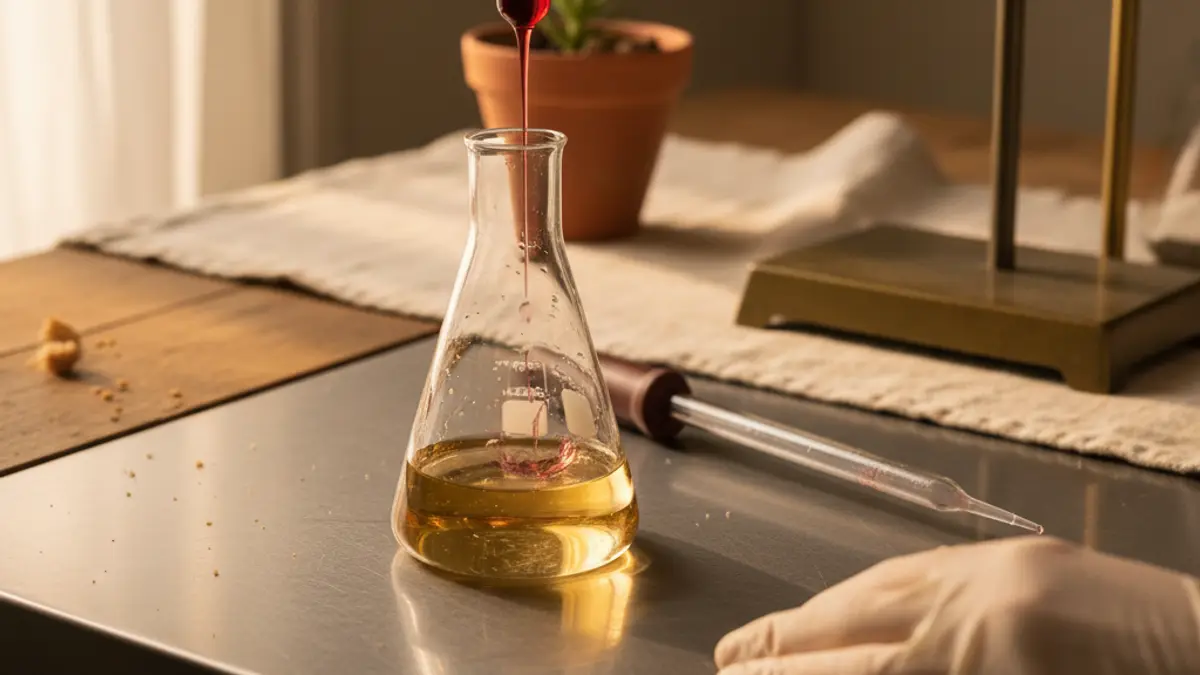
Why does almost every wine label say “contains sulphites”?
Nearly every bottle carries the phrase “contains sulphites” because the European Commission’s EU rules require the declaration once total sulphur dioxide exceeds 10 mg per litre. The European Commission’s threshold is a disclosure point rather than a statement that the wine has reached its category ceiling. The declaration therefore confirms presence above the threshold without reporting an exact amount.
The wording “contains sulphites” is easy to interpret too broadly. Under the European Commission’s EU rule, the phrase means that total sulphur dioxide exceeds 10 mg per litre. The phrase does not mean that a wine contains the maximum permitted amount, that the producer used an unusually large addition or that the wine belongs to a particular style.
The European Commission’s threshold also explains why the declaration is not a useful ranking system for comparing sulfite content across bottles. Every bottle above 10 mg per litre can carry the same wording even though the bottles may not contain the same total sulphur dioxide amount. The label alone cannot identify which declared bottle contains less.
A “contains sulphites” declaration and a “no added sulphites” claim answer different questions. The European Commission’s declaration concerns total sulphur dioxide above 10 mg per litre, while the producer’s claim concerns whether sulphur dioxide was added. The statements are not logically interchangeable, and a production claim does not provide a bottle-specific total unless the producer supplies that information separately.
The European Commission’s declaration is also not an ingredient-style inventory of every relevant wine characteristic. The phrase does not state the wine’s calorie content, alcohol content, residual sugar amount or production history. Readers researching a separate nutrition question can consult VinSip’s wine calories guide, while recognising that calories are not a measure of total sulphur dioxide.
The European Commission’s rule does not turn the declaration into proof of medical causation. A headache occurring after wine and a label carrying “contains sulphites” may occur together, but the label establishes only that the regulatory threshold has been crossed. The declaration does not isolate sulfites from every other characteristic of the wine or from the circumstances in which it was consumed.
The spelling on labels may use “sulphites,” while general discussions may use “sulfites.” VinSip treats “sulfites” and “sulphites” as spelling variants for the same general term in this context, but VinSip preserves “contains sulphites” as the EU label wording supplied in the European Commission’s rule. Total sulphur dioxide remains the stable term for the measured regulatory quantity.
The European Commission’s labelling rule supports a narrow and useful reading. A declared bottle exceeds 10 mg per litre of total sulphur dioxide. No exact bottle content, production method, organic status, quality assessment or medical conclusion follows from that wording alone.
A consumer seeking a precise total sulphur dioxide amount must look beyond the standard declaration. The European Commission’s wording supplies a threshold disclosure, while a producer may choose to publish a technical analysis for a particular wine. Without that additional information, comparing declared bottles by exact sulfite content is not possible from the label phrase alone.
Do sulfites in wine cause headaches?
The European Commission’s sulfite rules do not establish that sulfites cause a headache after wine. Commission Regulation (EU) 2019/934 governs oenological practices and permitted substances, while the European Commission’s “contains sulphites” rule governs disclosure above 10 mg per litre. Neither regulatory fact identifies the cause of an individual symptom.
The prominent label wording can make sulfites appear to be the obvious explanation for any unpleasant experience after wine. The European Commission’s declaration, however, establishes only that total sulphur dioxide exceeds the labelling threshold. The declaration does not show that sulfites caused a later headache, and it does not separate sulfites from the other properties of a particular wine or the circumstances of consumption.
The European Commission’s category limits also undermine a simple claim that red wine must be the higher-sulfite choice. The European Commission sets a total sulphur dioxide ceiling of 150 mg per litre for dry red wine and 200 mg per litre for dry white and rosé wine. A headache associated with red wine therefore cannot be attributed to sulfites merely by assuming that the red category has the higher EU ceiling.
A regulatory maximum is not an analysis of the bottle that was consumed. The European Commission’s dry-wine limits show the highest amount permitted in the relevant categories, but they do not show the actual total sulphur dioxide in a particular red, white or rosé wine. A symptom report cannot be matched to a precise sulfite exposure by using the category ceiling alone.
The European Commission’s “contains sulphites” declaration has the same limitation. The wording confirms total sulphur dioxide above 10 mg per litre, but it does not state the actual amount. A comparison between bottles carrying the same declaration cannot reveal which bottle contained more total sulphur dioxide without additional producer data.
A “no added sulphites” bottle is not a controlled test of the headache question. The producer’s claim describes an addition choice rather than every characteristic of the finished wine, and the claim does not provide a measured total sulphur dioxide amount. Differences between wines also prevent the production claim from isolating sulfites as the only relevant variable.
The most accurate conclusion supported by the cited regulatory information is limited. The European Commission’s limits and label rules explain what may be present, what maximum applies and when disclosure is required. The rules do not diagnose a headache or prove that the disclosed substance caused it.
A person with a worrying reaction should seek individual advice from an appropriate healthcare professional rather than relying on wine colour, a category ceiling or the standard “contains sulphites” declaration. That recommendation reflects the limits of what the European Commission’s regulatory information can establish about an individual event. The page does not provide a diagnosis or a substitute for clinical assessment.
Consumers can still record bottle-specific information when trying to describe a pattern accurately. Useful details include the wine category, the exact label claims and any technical information supplied by the producer. Such records can improve the description of an event, but the European Commission’s regulatory framework does not turn those observations into proof of causation.
How much lower are the EU sulphur dioxide limits for organic wine?
The European Commission’s EU organic wine rules set lower total sulphur dioxide ceilings than the corresponding conventional dry-wine ceilings. For organic wine with under 2 g of sugar per litre, the European Commission sets a ceiling of 100 mg per litre for red wine and 150 mg per litre for white and rosé wine. The European Commission raises each organic ceiling by 30 mg per litre above that sugar threshold.
The European Commission’s conventional dry-wine limits are 150 mg per litre for dry red wine and 200 mg per litre for dry white and rosé wine. The European Commission’s organic ceilings are therefore more restrictive for the specified low-sugar categories. Organic status does not mean that total sulphur dioxide must be absent.
| Organic wine category | Total sulphur dioxide ceiling |
|---|---|
| Red wine | 100 mg per litre |
| White wine | 150 mg per litre |
| Rosé wine | 150 mg per litre |
The sugar condition is part of the European Commission’s organic rule and should remain attached to the figures. The ceilings of 100 mg per litre for organic red wine and 150 mg per litre for organic white and rosé wine apply where the wine has under 2 g of sugar per litre. The European Commission raises each applicable organic ceiling by 30 mg per litre above that threshold.
An organic wine ceiling is a maximum rather than a guaranteed bottle content. The European Commission’s organic rule limits the permitted total sulphur dioxide for the applicable category, but the rule does not state that every organic wine contains the maximum. A bottle-specific amount requires producer information or an appropriate analysis.
The European Commission’s lower organic ceilings do not remove the labelling requirement. The European Commission requires “contains sulphites” once total sulphur dioxide exceeds 10 mg per litre, including where an organic wine remains within its lower applicable ceiling. An organic bottle may therefore carry the same declaration as a conventional bottle.
Organic certification and “no added sulphites” are different claims. The European Commission’s organic rules impose lower applicable total sulphur dioxide ceilings for specified categories, while a “no added sulphites” statement describes a producer’s addition choice. Neither claim should be substituted for the other.
Organic status also does not answer separate questions about vegan production, calories, alcohol or individual symptoms. Readers seeking a broader explanation of the category can consult VinSip’s organic wine guide. Readers researching animal-derived processing aids can consult VinSip’s guide to vegan wines.
The European Commission’s organic rule supports a precise but limited conclusion. Qualifying organic wines operate under lower total sulphur dioxide ceilings than the cited conventional dry-wine categories. The organic label does not disclose the exact amount in the bottle, guarantee that the bottle falls below 10 mg per litre or establish that the wine will produce a particular experience for an individual drinker.
A buyer comparing organic and conventional bottles should therefore distinguish category limits from measured contents. The European Commission’s ceilings describe what is permitted, while the producer is the relevant source for a bottle-specific technical figure. Without that figure, the lower organic ceiling supports a regulatory comparison but not an exact comparison between particular bottles.
Can wine be described accurately as having no added sulphites?
Wine can be described as having “no added sulphites” when the claim refers to the producer’s decision not to add sulphur dioxide. A “no added sulphites” claim is a production statement, while total sulphur dioxide is the measured quantity used by the European Commission’s EU rules. The production statement does not by itself report the finished wine’s total sulphur dioxide content.
The distinction matters because “no added sulphites” and “contains sulphites” answer different questions. The producer’s claim concerns addition, while the European Commission’s declaration applies once total sulphur dioxide exceeds 10 mg per litre. A reader should not treat the absence of an addition as equivalent to a laboratory statement showing no total sulphur dioxide.
“Sulfite-free” is a broader claim than “no added sulphites.” The broader wording appears to describe the contents of the finished wine, while the narrower wording describes a production choice. A buyer seeking certainty about total sulphur dioxide should request a bottle-specific figure rather than infer complete absence from a production phrase.
Commission Regulation (EU) 2019/934 sets the oenological practices and permitted substances for EU winemaking, including sulphur dioxide. The European Commission’s permission means that added sulphur dioxide can fall within ordinary regulated EU winemaking practice. The use or non-use of a permitted substance does not by itself rank a wine as better, worse, artisanal or industrial.
A no-added-sulphites claim also does not determine the ceiling that applies to the wine. The European Commission’s limits depend on regulatory category, including distinctions involving wine type, residual sugar and organic status. A production claim cannot replace the category information needed to identify the relevant ceiling.
The European Commission’s “contains sulphites” rule remains a threshold disclosure rather than a complete composition statement. If a bottle carries that declaration, the supported conclusion is that total sulphur dioxide exceeds 10 mg per litre. The label still does not disclose the exact total or explain how that total relates to the producer’s production choices.
Handling and storage are separate considerations from the precise meaning of the claim. Readers considering bottle care can consult VinSip’s guide to storing wine, while readers considering an opened bottle can consult VinSip’s guide to how long wine lasts. Neither storage guidance nor an addition claim changes the European Commission’s regulatory definition of total sulphur dioxide.
A no-added-sulphites claim should not be presented as a proven headache solution. The European Commission’s regulatory information does not identify the cause of an individual headache, and the production claim does not isolate every relevant feature of the wine. A person seeking a medical conclusion needs more than a front-label production statement.
The most careful consumer reading is narrow. “No added sulphites” means that the producer reports no sulphur dioxide addition, while “contains sulphites” means that total sulphur dioxide exceeds the European Commission’s threshold of 10 mg per litre. Neither phrase provides an exact bottle-specific total unless the producer supplies additional technical information.
Are non-alcoholic wines automatically free from sulfites?
Non-alcoholic wine should not be assumed to be free from sulfites. The European Commission’s sulphur dioxide rules concern permitted oenological practices, total sulphur dioxide ceilings and disclosure, while the description “non-alcoholic” addresses a different product characteristic. A claim about alcohol does not provide a total sulphur dioxide measurement.
The European Commission requires “contains sulphites” once total sulphur dioxide exceeds 10 mg per litre for wine sold under the relevant EU rule. A buyer comparing wine alternatives should therefore read each product’s own allergen declaration and producer information. The word “non-alcoholic” does not replace the sulphite declaration.
A non-alcoholic wine label may contain several separate statements, and each statement should be interpreted only for the subject it addresses. The European Commission’s “contains sulphites” wording communicates that the total sulphur dioxide threshold has been crossed. A separate alcohol-related statement does not indicate whether the product is above or below that threshold.
Readers comparing products can consult VinSip’s guide to non-alcoholic wines. Product-specific labels and producer information remain necessary for sulfite questions because category names do not disclose an exact total sulphur dioxide amount. The same caution applies when comparing organic, vegan and no-added-sulphites claims.
The most reliable reading practice is to keep each term attached to its defined subject. Total sulphur dioxide is the regulatory measure for sulfite limits and disclosure, “no added sulphites” is a production claim, organic is a certification category with lower specified ceilings, and non-alcoholic describes a separate characteristic. Combining those terms into a broader assumption can produce conclusions that the European Commission’s rules do not support.
Bottom line
Sulfites are sulphur-containing compounds covered by European Commission rules for EU winemaking, and total sulphur dioxide is the regulatory measure used for ceilings and disclosure. The European Commission sets EU total sulphur dioxide limits of 150 mg per litre for dry red wine and 200 mg per litre for dry white and rosé wine, with higher ceilings for wines carrying more residual sugar. The European Commission requires “contains sulphites” once total sulphur dioxide exceeds 10 mg per litre, which explains why nearly every bottle carries the wording but does not reveal a bottle’s exact amount. For organic wine with under 2 g of sugar per litre, the European Commission sets lower ceilings of 100 mg per litre for red wine and 150 mg per litre for white and rosé wine, raising each by 30 mg per litre above that sugar threshold. Commission Regulation (EU) 2019/934 sets the oenological practices and permitted substances for EU winemaking, including sulphur dioxide. A “no added sulphites” claim describes an addition choice rather than an exact total sulphur dioxide measurement, and the European Commission’s regulatory limits and label wording do not establish the cause of an individual headache after wine.
Primary sources
Every figure on this page comes from the body named in the sentence that states it. Here is where to check each one: