

What can a wine app actually tell you reliably?
A wine app can reliably repeat visible label data when the image is legible and the catalogue match is correct. A wine app can also help a user search for a producer, save a bottle record, compare stated label details and locate stored notes associated with the matched catalogue record. Reliability falls when the label is unclear, the catalogue is incomplete or the wine app connects the image to a similar but different wine.
VinSip presents visible label data and information associated with a catalogue record; VinSip does not establish facts that the label and catalogue do not contain. A useful result may show the producer, wine name, vintage, stated origin, printed alcoholic strength and sulphite wording. The user should still compare every important field in the result with the bottle before saving, buying or sharing the record.
A catalogue match needs to identify the particular wine represented by the visible label data rather than a similarly named product. Producer names, wine names, vintages, bottlings and labels used in different markets can create plausible but incorrect results. A polished result page does not remove the need to confirm that the returned catalogue record corresponds to the bottle.
Printed alcoholic strength illustrates the difference between reading label data and measuring the liquid. EUR-Lex publishes the European Commission’s Regulation (EU) 2019/33, under which printed alcoholic strength may differ from analysed strength by up to 0.5% vol and by 0.8% vol for sparkling, liqueur and long-bottled wines. A wine app that accurately reads printed alcoholic strength therefore reports the label claim rather than a more precise analysis of the liquid.
No wine app reading a label can be more precise about alcoholic strength than the label itself. EUR-Lex publishes the European Commission’s Regulation (EU) 2019/33, which permits the stated differences between printed alcoholic strength and analysed strength. The distinction remains relevant even when the text recognition and catalogue match are flawless.
Sulphite wording also illustrates the limits of label data. EUR-Lex publishes the European Union requirement that wine labels carry “contains sulphites” above 10 mg per litre, and the wording does not disclose how much sulphur dioxide the wine contains below the legal ceiling. A wine app can read the sulphite wording, but it cannot use that wording to measure sulphur dioxide in the liquid.
A wine app result can be useful without being a complete account of the bottle. Visible label data can support shopping comparisons, cellar records and searches for published material, while questions about the liquid require direct evidence. Readers can review how to read a wine label for an explanation of common label elements and sulphites in wine explained for the distinction between allergen wording and the amount present in the wine.
| Visible label data | What a wine app can report | What the result cannot establish |
|---|---|---|
| Producer and wine name | The wine app can read the printed identity and search for a catalogue record. | The result cannot prove that the catalogue match represents the particular bottle and its contents. |
| Vintage and stated origin | The wine app can record the vintage and origin shown on the label. | The result cannot verify the liquid independently of the label. |
| Printed alcoholic strength | The wine app can repeat the printed alcoholic strength. | The result cannot measure analysed alcoholic strength. |
| Sulphite wording | The wine app can read the printed allergen wording. | The result cannot measure sulphur dioxide in the liquid. |
| Catalogue notes | The wine app can retrieve notes associated with the matched catalogue record. | The notes cannot establish the liquid condition of the bottle being examined. |
What can no wine app tell you from a photograph?
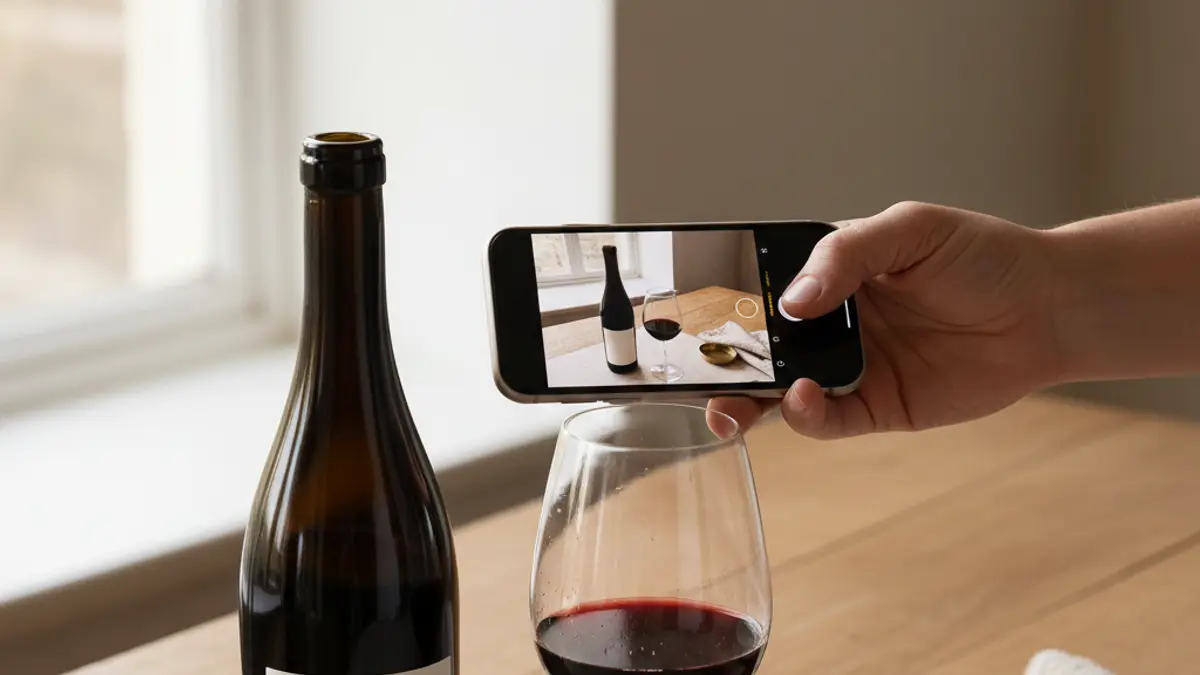
No wine app can determine liquid condition from a photograph of a bottle. A photograph can show visible packaging and label data, but it provides no chemical, sensory or microbiological sample of the wine. A wine app therefore cannot remotely taste the wine, analyse the liquid or guarantee that the contents are sound.
A bottle image may show visible features such as label wear, capsule condition, apparent fill level or sediment. Visible features can prompt closer inspection, but they do not amount to a diagnosis of liquid condition. A clean label does not prove careful storage, and visible wear does not prove that the wine is damaged.
Sediment visible through the bottle does not allow a wine app to determine whether the wine is sound or faulty. The image shows appearance under particular lighting and photographic conditions, not the aroma, flavour or stability of the liquid. A photograph-based interpretation should therefore remain an observation about appearance rather than a conclusion about drinkability.
A wine app also cannot reconstruct storage and transport from a bottle photograph. Heat exposure, light exposure, seal performance, transport and handling may affect liquid condition without producing a conclusive sign in the image. Visible packaging can provide context, but a wine app cannot turn incomplete visual context into a verified storage history.
A catalogue tasting note cannot establish the liquid condition of the bottle in front of the user. The tasting note is stored information associated with a catalogue record, not sensory evidence collected from the particular bottle. Even a correctly matched note describes an expected or previously reported experience rather than the present contents.
A rating, professional review, flavour tag or recommendation is judgement rather than a measurement of liquid condition. A wine app can organise judgements and help a reader compare stated preferences, but the wine app cannot guarantee that the reader will share those preferences. A favourable rating also cannot prove that a particular bottle has avoided damage or a wine fault.
The question of whether wine apps work requires a defined task. Wine apps can work well for reading visible label data, retrieving a catalogue record and maintaining a personal record when the catalogue match is correct. Wine apps do not work as remote tasting devices, laboratory instruments, storage monitors or direct examinations of the liquid.
Catalogue descriptions can contain technical wine language that readers interpret differently. The wine glossary explains common terms and helps separate a style description from a claim about personal preference or bottle condition. Understanding the terminology does not remove the need to assess the particular wine after opening.
Can a wine app tell whether the bottle in front of you is faulty?
No wine app can tell whether a sealed bottle is faulty from a label scan or photograph. A wine fault exists in the liquid and requires sensory assessment or analysis of that liquid. Visible label data, bottle shape, barcode information and crowd judgement cannot diagnose a wine fault.
Cork taint demonstrates the limit clearly. The Australian Wine Research Institute reports that some assessors detect TCA in wine below 1 nanogram per litre, and the Australian Wine Research Institute explains that nothing visible on a bottle indicates cork taint. A wine app can identify a catalogue record, but the catalogue record cannot reveal whether cork taint is present in the particular liquid.
A bottle affected by a wine fault may still have the expected label, capsule, closure branding and catalogue record. A bottle with worn packaging, a stained label or visible sediment may still contain sound wine. Packaging appearance and liquid condition are separate forms of evidence, so neither should be treated as a substitute for the other.
Comments from other users cannot diagnose the bottle being opened. A comment may describe the writer’s own bottle, serving conditions, preferences or catalogue match. Even if a comment accurately describes a wine fault in the writer’s bottle, the comment does not establish the liquid condition of a different bottle.
Ratings should not be used as a wine fault check. A favourably rated wine may disappoint because the particular bottle is affected by cork taint, oxidation or other damage, while an unfavourably rated wine may be sound but unsuited to the reviewer’s preferences. Rating judgement and diagnosis of liquid condition answer different questions.
A wine app can still help document a suspected problem after opening. The user can record the visible label data, preserve the catalogue identity, save notes about the aroma or flavour and retain information needed for communication with a retailer or producer. The saved record documents the report; it does not independently prove the cause of the problem.
The guide to wine faults and what they mean explains common symptoms that may become apparent after opening a bottle. Descriptions can help a reader communicate what was smelled or tasted, but a wine app result cannot prove that a sealed bottle is sound or faulty.
Can a wine app tell whether a wine is authentic?
No wine app can authenticate a bottle from visible label data alone. Authentication requires evidence that the packaging and contents genuinely correspond to the claimed producer, wine, vintage and provenance. A catalogue match can support an inquiry, but a catalogue match is not an authentication certificate.
A wine app may identify an apparent discrepancy in spelling, label design, stated origin, vintage or other visible label data. An apparent discrepancy can provide a reason to examine the bottle and seller information more carefully. The discrepancy does not by itself prove that the bottle is counterfeit, because legitimate labels can vary across markets, releases and packaging conditions.
A plausible catalogue match does not prove authenticity. A convincing copy may reproduce visible label data, while a genuine bottle may be difficult to match because of label wear, importer stickers, photographic quality or incomplete catalogue coverage. Catalogue presence shows that a corresponding record exists; it does not establish the history or contents of the bottle being examined.
Catalogue absence does not prove that a bottle is counterfeit. A catalogue may omit the wine, the particular vintage, a market-specific label or a less common bottling. A failed scan may also result from glare, damage, an obstructed label or a catalogue entry stored under different wording.
Authentication concerns packaging, contents and provenance rather than label recognition alone. A photograph cannot establish ownership history, purchase history, storage history, supply-chain records or the relationship between the visible bottle and the liquid inside it. Those questions require direct evidence and may require specialist examination where the risk warrants it.
A wine app should therefore be used as a reference tool during an authenticity inquiry. The wine app can help compare visible label data, find known catalogue information and make inconsistencies easier to notice. The wine app cannot resolve an authenticity dispute or replace evidence supplied by a producer, seller, documented source or appropriate specialist.
A buyer for whom authenticity materially affects the decision should examine the seller, provenance documentation and physical bottle rather than relying on a scan result. A strong visual match may be reassuring, but reassurance is not proof. A failed visual match may justify caution, but caution is not a finding that the bottle is counterfeit.
How wrong is a wine app likely to be?
Wine app accuracy depends on the type of claim being assessed. A wine app may accurately read clear label data while returning an incomplete catalogue record, an incorrect vintage, an unsuitable tasting note or judgement that does not match the reader’s preferences. Recognition accuracy, catalogue accuracy and rating usefulness should therefore be evaluated separately.
Image quality affects recognition accuracy because the wine app must interpret visible label data before searching the catalogue. Glare, curved glass, decorative type, label damage, obstruction and an angled photograph can reduce the clarity of the text presented to the wine app. A confident-looking result does not demonstrate that the initial reading was correct.
Catalogue coverage affects catalogue accuracy because the wine app can return only information represented in its stored records. Vivino publishes 19.6 million wines in its database against 3.26 billion scans, showing that even a very large catalogue is small relative to the label-and-vintage combinations in circulation. The comparison published by Vivino does not provide an error rate, but it explains why a returned catalogue record may be a close match rather than the exact wine.
A recurring wine name can make a close catalogue match appear exact. Different vintages, bottlings, markets and producers may share visually similar wording or packaging. The user should compare the producer, wine name, vintage, stated origin and other visible label data before accepting the catalogue match.
The question “is Vivino accurate” has no universal answer because the word “accurate” can refer to recognition, stored catalogue data or user judgement. Vivino may return an appropriate catalogue record for a clear and well-represented label, while the associated rating remains a summary of user judgement rather than a measurement. The same distinction applies to VinSip and other wine apps.
Rating usefulness depends on the reader’s purpose and preferences. A displayed rating can combine judgements formed under different serving conditions, bottle conditions, contexts and expectations. The resulting value may describe how participating users responded, but it cannot guarantee quality, value, suitability or enjoyment for a particular reader.
Rating displays can create an appearance of precision that the underlying judgements do not support. Judgement remains subjective even when a wine app aggregates many responses, because agreement among users does not turn preference into a laboratory measurement. A reader should consider who supplied the judgement, which wine and vintage were reviewed and what purpose the rating serves.
The guide to wine scores explained describes how to interpret ratings alongside reviewer identity, wine identity and intended use. The guide to the best wine apps compares common functions across wine apps. Neither a high rating nor a feature-rich wine app removes the need to verify the catalogue match against the bottle.
A practical accuracy check begins with visible label data. The user should compare the producer, wine name, vintage, stated origin, printed alcoholic strength and sulphite wording with the returned catalogue record before relying on it. Any mismatch should be treated as a reason to search again or enter the record manually rather than as evidence about the liquid.
Can you trust wine app ratings?
Wine app ratings can be trusted only as records of user judgement gathered and presented by the wine app. A rating is not a direct measurement of quality, value, authenticity or liquid condition. The usefulness of a rating depends on the identity of the wine, the relevance of the participating users and the decision the reader is trying to make.
A high rating does not guarantee that the reader will enjoy the wine. Personal preferences differ across sweetness, acidity, tannin, body, aroma, maturity and serving context. A rating can indicate a pattern of approval among contributors without predicting the response of a particular person.
A low rating does not establish that the wine is faulty. The contributors may dislike the style, may have tasted the wine under unsuitable conditions or may have attached a judgement to an incorrect catalogue record. Diagnosis of a wine fault requires evidence from the liquid rather than an aggregated rating.
A rating also cannot confirm that the bottle being purchased is in the same condition as bottles assessed by contributors. Storage, transport, closure performance and handling can differ between bottles. Even a relevant catalogue rating remains separate from the liquid condition of the bottle in front of the user.
Wine app ratings are most useful when treated as a starting point for comparison rather than a command to buy or avoid. Written notes may reveal why contributors liked or disliked the wine, allowing the reader to compare those preferences with personal taste. The wine scores explained guide provides further context for reading scores without mistaking judgement for measurement.
What should you never use a wine app to decide?
A wine app should never be the only basis for deciding that a particular bottle is sound, suitable for a personal medical need, authentic or worth a particular expenditure. A wine app can support decisions with visible label data, catalogue information and stored judgement. A wine app cannot inspect the liquid, verify provenance or evaluate an individual’s health circumstances.
A label scan should not be used to conclude that a bottle is free from sulphites. EUR-Lex publishes the European Union requirement that wine labels carry “contains sulphites” above 10 mg per litre, but EUR-Lex’s published requirement does not make the wording a complete measurement of sulphur dioxide in the wine below the legal ceiling. A wine app can read the wording without determining the amount in the liquid.
A wine app’s inferred categories should not replace bottle information, producer information or qualified professional advice for an allergy, dietary or medical decision. A catalogue record may be incomplete, may describe a different vintage or may be connected to the wrong bottle. Personal health decisions require evidence suited to the individual and the substance in question.
A wine app rating should not be the only reason to buy wine for a meaningful occasion, select a gift or dismiss an unfamiliar producer or region. Rating judgement may not match the recipient’s preferences, the intended food or the condition of the particular bottle. Written descriptions, reliable seller information and knowledge of the intended drinker can provide context that a displayed rating lacks.
A catalogue result should not settle an authenticity dispute. A genuine wine record can be attached to an inauthentic bottle, while a genuine bottle can fail to match because the catalogue is incomplete or the photograph is difficult to read. Authentication requires evidence about the bottle, contents and provenance rather than catalogue presence alone.
A photograph-based result should not be used to accept or reject a suspected wine fault. The liquid must be assessed after opening, and a serious dispute may require evidence beyond a wine app. The Australian Wine Research Institute reports that some assessors detect TCA in wine below 1 nanogram per litre and that nothing visible on a bottle indicates cork taint, which demonstrates why a bottle image cannot answer the question.
A wine app is appropriately used to read, find, compare and remember visible label data and catalogue information. Direct evidence is needed to determine liquid condition, authentication, provenance and suitability for a personal health decision. Maintaining that boundary preserves the practical value of wine apps without claiming certainty that a photograph and catalogue cannot provide.
Bottom line
A wine app is useful for reading visible label data, searching for a catalogue record and organising information about a bottle. A correct result can identify the producer, wine name, vintage, stated origin, printed alcoholic strength and sulphite wording, but the user should verify the catalogue match against the bottle. A wine app cannot inspect the liquid, diagnose a wine fault, authenticate a bottle, verify provenance or guarantee that a rating predicts personal enjoyment.
EUR-Lex publishes the European Commission’s Regulation (EU) 2019/33, under which printed alcoholic strength may differ from analysed strength by up to 0.5% vol and by 0.8% vol for sparkling, liqueur and long-bottled wines. No wine app reading printed alcoholic strength can be more precise than the label. EUR-Lex also publishes the European Union requirement that wine labels carry “contains sulphites” above 10 mg per litre, but the wording does not disclose how much sulphur dioxide the wine contains below the legal ceiling.
The Australian Wine Research Institute reports that some assessors detect TCA in wine below 1 nanogram per litre and that nothing visible on a bottle indicates cork taint. Vivino publishes 19.6 million wines in its database against 3.26 billion scans, showing that even a very large catalogue is small relative to the label-and-vintage combinations in circulation. Wine app ratings should therefore be treated as stored judgement, catalogue matches should be checked against visible label data and direct evidence should be used for questions about liquid condition, authentication, provenance, health or substantial spending.
Primary sources
Every figure on this page comes from the body named in the sentence that states it. Here is where to check each one: